
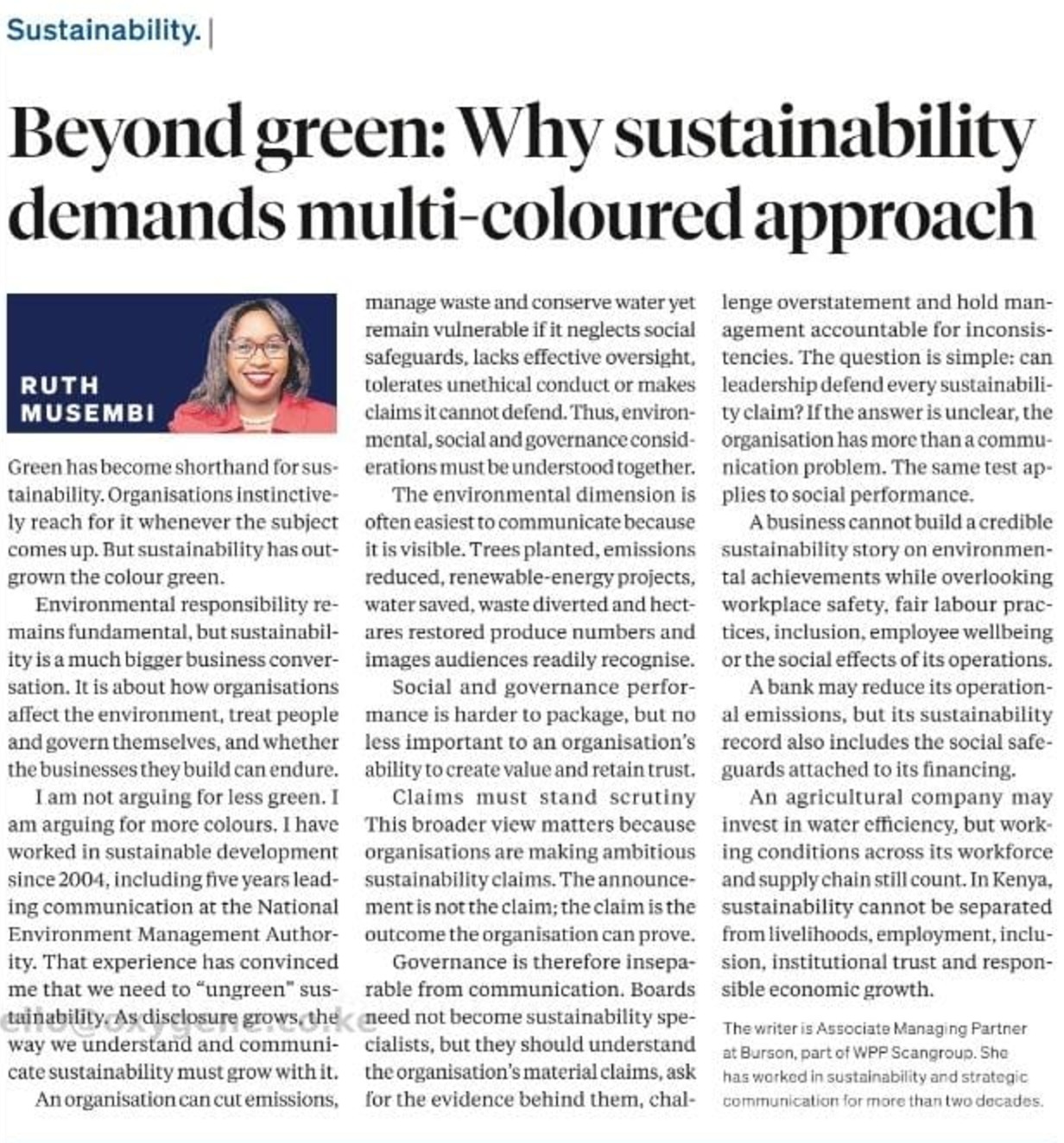
This column by Ruth Musembi, founder of Sustainability Africa, appeared in the Business Daily’s Sustainability section. The newspaper page is reproduced below, followed by a summary of her argument.
The argument in brief
Musembi’s starting point is that environmental performance has come to stand in for the whole of sustainability. She does not want less attention on the environment. Her case is that social performance and governance belong in the same frame, because together they decide whether a business creates value, keeps trust and lasts.
“I am not arguing for less green. I am arguing for more colours.”
Why environmental stories dominate
Environmental results are visible and easy to count, so they fill most sustainability communication. Social and governance performance is harder to show and gets less attention. Yet a company with strong environmental numbers stays exposed if it is weak on safeguards, oversight or ethics, or if its claims do not hold up.
Claims must hold up
As disclosure requirements grow and commitments get bolder, Musembi argues that what matters is the outcome an organisation can prove, not the announcement. That ties governance and communication together. Directors have a clear role even without specialist knowledge: knowing which claims matter most, asking what supports them and holding management to account where they are overstated. If leaders cannot stand behind each claim, she says, the issue is not how it was communicated.
What it looks like in practice
Her examples are a bank that cuts its own emissions but must also answer for the social safeguards on its lending, and a farm business that saves water but must also account for working conditions across its workforce and suppliers. In Kenya, she concludes, sustainability is bound up with livelihoods, jobs, inclusion, trust in institutions and responsible growth.
Ruth Musembi is the founder of Sustainability Africa. She has worked in sustainable development since 2004, including five years leading communication at the National Environment Management Authority. This column was first published in the Business Daily.